Home›Concepts›Imbalances and Price Gaps›Sellside Imbalance Buyside Inefficiency
Concept 23 · Category B
ICT Sellside Imbalance Buyside Inefficiency (SIBI) Explained
Sellside Imbalance Buyside Inefficiency · SIBI
What is Sellside Imbalance Buyside Inefficiency in ICT?
An ICT label for a bearish FVG-type imbalance formed during downward price delivery.
Definition of Sellside Imbalance Buyside Inefficiency
Typically the bearish FVG configuration, where candle 1 low is above candle 3 high.
How to identify Sellside Imbalance Buyside Inefficiency
Apply the three-candle bearish FVG rule and mark between candle 3 high and candle 1 low.
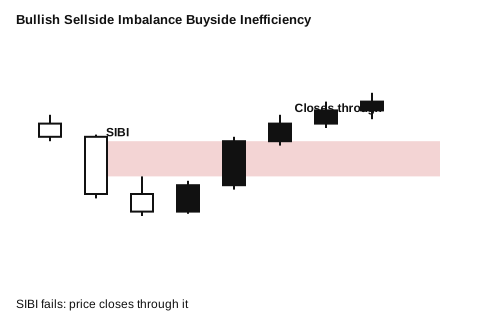
Bullish Sellside Imbalance Buyside Inefficiency example
a decisive break above it may invalidate its bearish role.
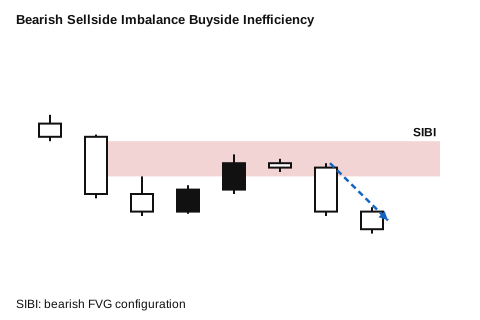
Bearish Sellside Imbalance Buyside Inefficiency example
downward displacement forms SIBI; price may retrace into it and continue lower.
Sellside Imbalance Buyside Inefficiency chart examples
Practical trading example
After a buy-side raid and bearish shift, mark the SIBI created by the sell impulse; a retracement into it may offer a short reference.
Common mistakes and important notes
A SIBI is not automatically resistance or a trade. Context and response matter.
Related ICT concepts
Part of Imbalances and Price Gaps. New to ICT? Start with the beginner guide.
ICT PD Arrays is an independent educational project and is not affiliated with or endorsed by Michael J. Huddleston. This page is not financial advice, and trading carries risk. Read the full disclaimer.