Home›Concepts›Imbalances and Price Gaps›Buyside Imbalance Sellside Inefficiency
Concept 22 · Category B
ICT Buyside Imbalance Sellside Inefficiency (BISI) Explained
Buyside Imbalance Sellside Inefficiency · BISI
What is Buyside Imbalance Sellside Inefficiency in ICT?
An ICT label for a bullish fair-value-gap type of imbalance: price delivers upward with an inefficient interval.
Definition of Buyside Imbalance Sellside Inefficiency
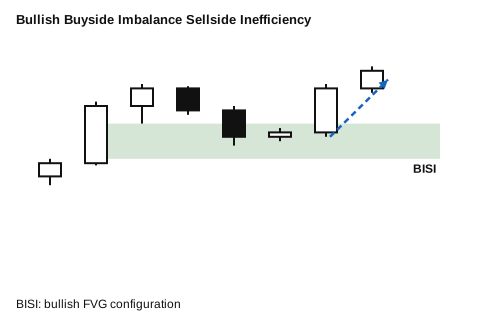
Typically the bullish FVG configuration, where candle 1 high is below candle 3 low.
How to identify Buyside Imbalance Sellside Inefficiency
Apply the three-candle bullish FVG rule and mark the interval between candle 1 high and candle 3 low.
Bullish Buyside Imbalance Sellside Inefficiency example
upward displacement forms BISI; price may retrace into it and continue higher.
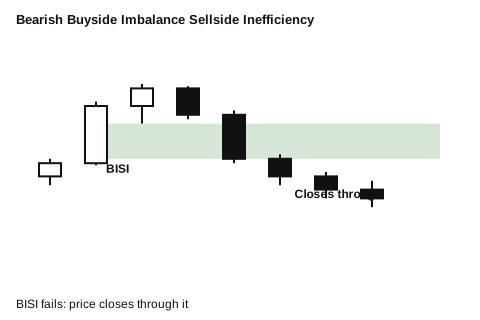
Bearish Buyside Imbalance Sellside Inefficiency example
if the BISI fails and price trades through it, it may cease acting as support.
Buyside Imbalance Sellside Inefficiency chart examples
Practical trading example
After a bullish MSS, identify a BISI left by displacement and use its retracement as one possible long-entry reference.
Common mistakes and important notes
The acronym expands as Buyside Imbalance, Sellside Inefficiency. It describes price delivery, not a standalone entry signal.
Related ICT concepts
Part of Imbalances and Price Gaps. New to ICT? Start with the beginner guide.
ICT PD Arrays is an independent educational project and is not affiliated with or endorsed by Michael J. Huddleston. This page is not financial advice, and trading carries risk. Read the full disclaimer.