What is Dealing Range in ICT?
A defined high-to-low price range used to measure premium, discount, equilibrium and internal/external liquidity.
Definition of Dealing Range
The selected swing high and swing low that bound the range under analysis.
How to identify Dealing Range
Select meaningful range boundaries; keep them fixed until the model's range-reset condition occurs; mark midpoint.
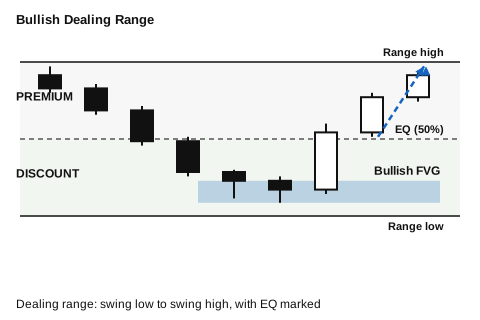
Bullish Dealing Range example
price trades into the lower half of the range and seeks upside liquidity.
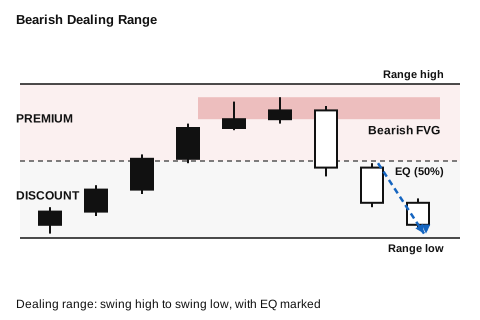
Bearish Dealing Range example
price trades into the upper half and seeks downside liquidity.
Dealing Range chart examples
Practical trading example
Use the latest clear daily swing low and high to map the current dealing range, then locate arrays relative to EQ.
Common mistakes and important notes
Different range choices produce different premium/discount readings. Explain why the boundaries were selected.
Related ICT concepts
Part of Market Structure. New to ICT? Start with the beginner guide.
ICT PD Arrays is an independent educational project and is not affiliated with or endorsed by Michael J. Huddleston. This page is not financial advice, and trading carries risk. Read the full disclaimer.